
Jennifer Berkshire, aka Edushyster, is one of the best bloggers on education. She is no ideologue and increasingly has come to the give voice to rarely listened-to local folks, especially in poor minority communities—including kids—who are most impacted by the tsunami, er “portfolio”, of education reform ideas.
In a recent post, Berkshire interviewed David Arsen, an expert on education finance at Michigan State University, about a new study he has coauthored on the financial mess that has ensued from Michigan’s school-funding and liberal “choice” policies.
Berkshire, who writes from Massachusetts, the birthplace of public education, was interested in the implications that Michigan’s story has for other states that are looking to open lots of new charter schools. Massachusetts, which rose to the top of the nation’s education performance with an education-reform strategy that kept a tight cap on charters, is in the process of dismantling its successful reforms; see here and here.
This November, Massachusetts is facing a highly controversial ballot initiative to significantly increase the number of charter schools in the Commonwealth.
In this post, I review Arson’s key findings, as well as the highlights of his interview with Berkshire. I then segue to the escalating fight over whether, and how, to lift the charter cap in Massachusetts.
Arsen’s study addresses the crucial “tipping point” question that every municipality with a sizeable number of charter schools confronts, but that few policy makers—in Michigan, Massachusetts or elsewhere—have been willing to address: What is the tipping point at which fostering charter schools, where students are more affluent and have fewer special needs, undermines traditional public schools and the children they serve?
Arsen’s study also shows that one result of Michigan policy has been to strip local school districts of control of their finances. As a consequence, the study shows, the poorest districts, which are predominantly African-American, are disproportionately impacted; their schools are most likely to be taken over by the state and, in many cases, handed over to charter operators.
But before we get into the nitty gritty of Arsen’s study and his interview with Berkshire, here’s some cautionary context on how Michigan’s education policy has played out in Detroit, where the forces of unbridled market competition were let loose on the city’s schools years ago.
Just a few weeks ago The New York Times published a scathing investigation of Detroit schools, which found the city with “lots of choice,” but “no good choice.”
The article by Kate Zernike concludes: “Michigan leapt at the promise of charter schools 23 years ago, betting big that choice and competition would improve public schools. It got competition, and chaos.”
Importantly, Zernike points out, that when the charter law passed in 1993, Detroit was neither in financial nor in academic crisis. Rather, a Republican governor, John Engler, driven by free-market ideology and a hatred of unions, embraced a marketplace for schools with as much competition as a Turkish Souk. “[O]ver the past five years, divisive politics and educational ideology and a scramble for money have combined to produced a public education fiasco that is perhaps unparalleled in the United States.”
“[T]he unchecked growth of charters has created a glut of schools competing for some of the nation’s poorest students, enticing them to enroll with cash bonuses, laptops, raffle tickets for iPads and bicycles. Leaders of charter and traditional schools alike say they are being cannibalized, fighting so hard over students and the limited public dollars that follow them that no one thrives.”
The charter landscape in Detroit is so bad it makes New Orleans, which has the largest concentration of charters in the country and, a decade after Hurricane Katrina, more than a few growing pains—see here and here and here and here look like a well oiled machine. While there is little transparency or regulation in either city, Detroit has so many charter authorizers that when a school’s charter is revoked for poor quality—as has often happened—they need only go shopping for a new authorizer; New Orleans, by contrast, has had only two main authorizers.
Arsen’s study, which looked at every school district in Michigan with at least 100 students and followed them for nearly two decades, found “that 80 percent of the explained variation in district fiscal stress is due to changes in districts’ state funding, to enrollment changes including those associated with school choice policies, and to the enrollment of high-cost, special education students.”
To put it simply, Arsen told Berkshire: We found that, overwhelmingly, the biggest financial impact on school districts was the result of declining enrollment and revenue loss, especially where school choice and charters are most prevalent.”
Arsen points out that Michigan has one of the most “highly centralized school finance systems” in the country. “[T]he state sets per pupil funding levels for each district, and most operating revenues follow students when they move among districts or charter schools. Districts have very limited authority to raise additional tax revenues for school operations from local sources.” Consequently, when enrollments decline, either because families move out of the district or put their children in charter schools, local authorities have little choice but to reduce spending.
Arsens study—see chart below—shows that the impact of this funding formula hits the mostly African-American central cities the hardest, with a 46 percent drop in inflation-adjusted school funding revenue between 2002 and 2013.
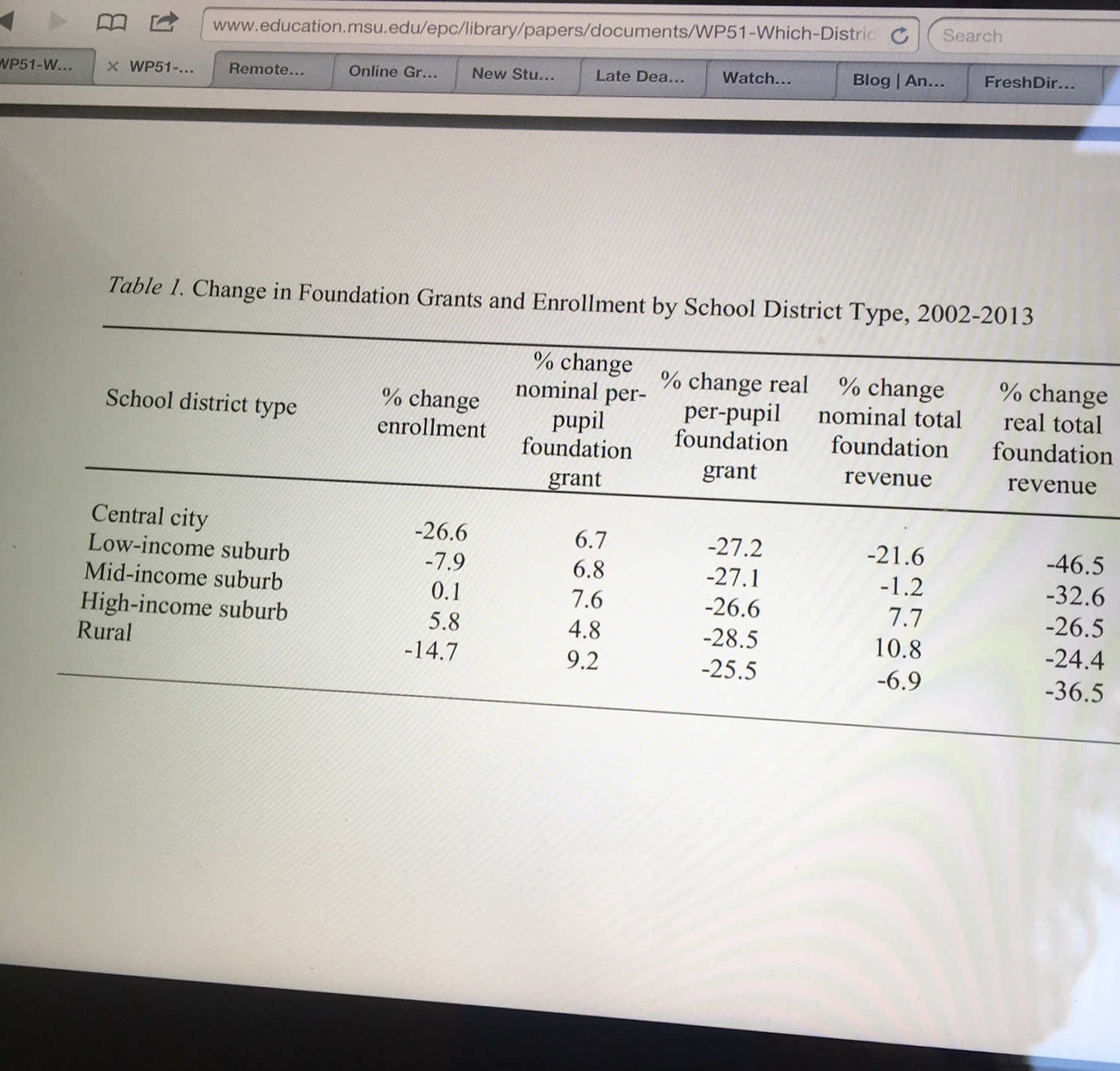
Poor districts suffer the greatest funding cuts
Says Arsen: “With numbers like that, it doesn’t really matter if you can get the very best business managers—you can get a team of the very best business managers—and you’re going to have a hard time handling that kind of revenue loss. The emergency managers, incidentally, couldn’t do it.”
The significance of Arsen’s study is twofold: First, the study addresses the tipping point problem, in which the state funding formula creates a zero-sum game in which increased charter penetration leads to ever greater financial stress on local public schools. Looking at districts with 15, 20 and 25 percent charter penetration, the study reveals that as charter penetration increases, the stress level on local public schools also goes up significantly. “What’s clear is that when the percentage gets up to the neighborhood of 20% or so, these are sizeable adverse impacts on district finances,” says Arsen.
One reason for this tipping-point problem is that increasing charter penetration turns the traditional public schools into “dumping grounds” for the neediest kids. Arsen’s study confirms that the number of special-education kids in public schools soars in districts with the highest charter-school penetration rates. Yet, Michigan covers less than 30 percent of the required costs of special education, so “these are costs that have to be absorbed by the school district’s general fund or through other local or county-level revenue sources.
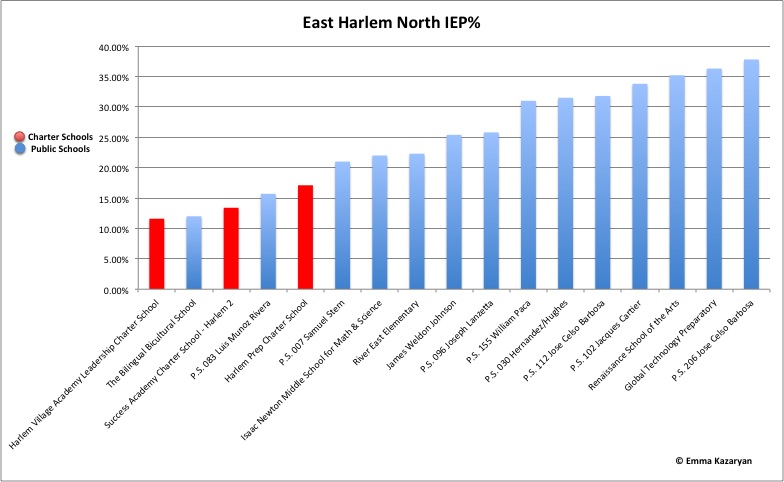
The same thing happened in Harlem where 25 percent of kids now attend charter schools. See more on the tipping point in Harlem here and chart below:


Kids in Harlem public schools are poorer and have more special needs than their charter-school counterparts
Second, Arsen argues, the state funding policy is designed to create a fiscal argument for wresting control of school districts from local officials. Now, instead of just using the low test scores of poor minority districts, state policy has created a fiscal bind that makes it virtually impossible for the poorest minority districts to stay above water. Like payday lenders who impose exorbitant interest rates on poor clients, trapping them in a cycle of debt from which they may never escape, Michigan has locked the poorest districts into ever-accelerating fiscal crisis.
Says Arsen: “The law presumes that financial problems in these districts are caused by poor decision making of local officials, and this justifies their displacement through emergency management. Yet our findings suggest that state school finance and choice policies were in large part responsible for the underlying financial problems. Once in control, however, emergency managers have moved aggressively to change district operations, closing schools, laying off administrators and teachers, cutting employee compensation, outsourcing services, and in two cases transferring the operation of the entire district to private charter management companies.”
Thus, the crisis of Michigan’s poorest, mostly African American school districts, are in a vicious cycle engineered, in large part, by state policy.
Berkshire’s interest in Michigan’s charter travails isn’t just academic. Massachusetts is facing enormous pressure, including a new ballot initiative in the November elections, to greatly expand its own charter sector. The charter push is led by Charlie Baker, the Republican governor of Massachusetts, and is backed by Baker’s secretary of education, James Peyser, who helped lead a ballot initiative in 2010 that would have eliminated the Commonwealth’s charter cap entirely. That ballot question was eventually scraped; in its place the cap on urban charter schools was raised from 9 percent to 18 percent, as part of the state’s successful Race-to-the-Top bid for $250 million in federal funding.
Lifting the charter cap is highly controversial in Massachusetts because charter schools played virtually no role in improving education in the Commonweath under its 23-year-old Education Reform Act. Massachusetts has only about 80 charters—though state law permits 120. Massachusetts charters are, for the most part, high performing, as measured by test scores, although in Boston, as in Harlem and elsewhere, charter-school demographics don’t look anything like that of their traditional-public-school counterparts. For example, charter schools in Boston still enroll only about 13 percent English Language Learners, compared to about 30 percent in public schools, according to Cara Stillings Candal, a researcher at the pro-charter Pioneer Institute.

Top line of graph shows number of English language learners is still about 17 points higher at public schools than at charter schools, represented by bottom line
Local education experts on both sides of the charter divide argue that Massachusetts charters work as well as they do partly because authorizers carefully scrutinize charter performance and ensure that only the best charters survive. Those opposed to raising the charter cap also argue that a tight cap has created an added incentive for authorizers to closely scrutinize charter operators.
While Boston charters outshine public schools on test scores, graduates of Boston public schools are more likely to graduate from college than do their charter counterparts, according to the Boston Opportunity Agenda 2015 annual report card, which is funded by, among others, the pro-charter Boston Foundation. The study sums up traditional public school college achievement with almost breathless praise: “The 27 Boston Public high schools are making tremendous progress on college completion. Since the baseline class of 2000, the percentage of students who complete a college degree or other postsecondary credential within six years of high-school graduation has grown from 35% to 50%. Additionally, the number of students enrolling at public institutions in Massachusetts who require developmental education or remediation is also declining.
Moreover, charter schools that produced college-graduation rates of 42 percent, eight points below their public school counterparts, have graduation classes dominated by girls. Somewhere along the way, the boys disappeared. In fact, among all these charter schools, only about 15 boys took home a sheepskin, according to…you guessed it… Jennifer Berkshire, who took a deeper dive into the numbers.
The bottom line, again, is that in Massachusetts, charter schools are a minuscule part of the ed-reform story. Indeed, given their small number, and the rigorous process for approving charters in Massachusetts, the real questions is: Why are college-completion rates for charter schools so low. Also: What happened to the boys?
Long gone are the days when Democratic state legislators in a grand bargain with a Republican governor, William Weld, hammered out the 1993 Education Reform Act. The battle over how, and by how much, to raise the charter cap has resulted in legislative deadlock with no compromise between two rival bills—a House bill in 2014 and a Senate bill in 2015—which would both have raised the cap by 23 percent, though the Senate bill included more checks and balances on charters and improved funding for all schools. The result is an all-or-nothing referendum, which would authorize 12 new charters a year, mostly in low-performing districts and “exempt” all “[n] ew charters and enrollment expansions approved under this law…from existing limits on the number of charter schools, the number of students enrolled in them, and the amount of local school districts’ spending allocated to them.”
The battle over the Bay State’s ballot initiative will heat up this fall. The highest stakes are in Boston where the public schools will lose an estimated $119 million this year, and endure sharp cuts in education programs, teachers, and in some cases “resources for the most vulnerable special needs students.
The budget squeeze is due at least in part to the funding drain created by the 7,100 students who have enrolled in charter schools, about 12 percent of Boston’s 5,700 public-school enrollment. With 22 charters in Boston, and an additional four in Cambridge, the Boston metro area has over one quarter of the state’s charter schools. (A dozen additional charter schools have opened and closed since the 1990s.)
In Massachusetts as elsewhere, school funding follows the child. Because the loss of students is spread unevenly across the system, the funding cuts have large ripple effects. When a new charter school attracts, say, 100 sixth graders, the losses don’t all come from a single school. Instead, they will be spread, potentially, across Boston’s 40 elementary and middle schools with sixth grade classes, which makes it difficult, if not impossible, to consolidate classes. Instead, the district has to start cutting programs. Massachusetts has put in place “shock absorbers” that are intended to provide the public-school system with a funding cushion, but these have worked “imperfectly, at best.”
In opposition to the budget cuts, Boston students staged protests last this spring. Jahi Spallos, a charter-school student and the leader of both public- and charter-school students who staged a walk out in response to the expected cuts, explained the impact on his school, Boston Green Academy, in a post on Edushyster: The school was “going to lose science classes, even though they are a core part of the curriculum and four years of science is a graduation requirement.” The school will also lose “extra curricular activities that could provide students with a full scholarship to college in the future.”
The referendum is being met with skepticism in many towns and cities that fear local schools will “lose funding when their students transfer” to charter schools. See here and here and here and here.
As the battle heats up, it is increasingly partisan. “What’s interesting is that, while charter advocates like to paint charter expansion as a progressive cause, there are signs that the issue is beginning to break along more traditional political lines,” says Berkshire.
The pro-charter lobby is backed by deep-pocketed business people, among them Abigail Johnson, CEO of Fidelity Investments, and John Kraft, president of the New England Patriots, who have pledged to spend up to $12 million on a ballot campaign.
Out-of-town billionaires are also joining the fight. Dimitri Melhorn, a DC-area venture capitalist, recently “slammed” a Boston parent who opposes the cap and blogs under the moniker “Public School Mama” likening her to opposition to that of a white supremacist.
The pro-charter lobby has reserved $6.5 million in ads for the week leading up to election day in November–ads that will be produced by SRCP Media of Washington, the firm best known for creating the “Swift Boat Veterans For Truth” campaign against John Kerry during the 2004 presidential campaign, which made “swift-boating” synonymous with the worst sort of underhanded attack. “The decision to hire a media firm responsible for bringing down, not just one Massachuestts presidential contender (Kerry AND Dukakis), raised some serious eyebrows,” adds Berkshire.
Meanwhile, Save Our Public Schools, an anti-referendum organization backed by a variety of labor organizations and the NAACP, is also planning to mount an ad campaign.
Whether the referendum passes or not, Massachusetts schools and children would benefit from more nuanced education policy. Notes Stanley Rosenberg, president of the Massachusetts State Senate, and his colleagues in an OpEd in Commonwealth magazine: “Ballot questions are blunt instruments. The ballot question on charter school expansion is no exception.
The OpEd authors drafted the Senate’s charter law, known as the Rise Act, which sought to address many of the problems that have dogged the charter industry, including lack of transparency and community involvement, as well as the cream-skimming of the best students. Key features included:
–Echoing the Commonwealth’s Education Reform Act, which tied significant increases in public school funding to accountability, in what became known as the “grand bargain,” the Rise Act ties a gradual increase in charter schools in the lowest-performing districts to roughly $20 million-per-year in additional school funding—for both charters and traditional public schools—over a seven-year period beginning in 2019. The bill’s sponsors argued that increasing the charter cap alone would cost the Commonwealth $1 billion and impact less than 10 percent of its children.
–The bill increases transparency, a major problem in many jurisdictions with charter schools, by requiring “public disclosure of charter school finance, contracts, policies, and board meetings consistent with disclosure requirements for traditional public schools.”
–It aims to strengthen community involvement by requiring charters and parents on their boards. And it would increase the ability of local school committees to reject charters in their communities—perhaps one of the most controversial items in the legislation.
–The bill called for an opt-out lottery, by which every child in a district is “automatically enrolled in the charter school lottery process, no application required.” But families would be permitted to decline a seat if it was offered to them.
Charter proponents have dismissed the Rise Act as merely “a statement of defiance.” But given the long-simmering charter disaster in Michigan, should the charter referendum fail and Massachusetts legislators get a second crack at crafting a new grand bargain, they would do well to revisit the draft law, which seeks to avoid some of the mistakes of other states.



 Andrea Gabor